By Richard Payne | Updated July 2026
Quick Answer
What happens on Closing Day in Halifax?
Closing day is when the legal ownership of your Halifax home transfers from the seller to you.
Most buyers sign their legal and mortgage documents and provide their closing funds one to three business days beforehand. On closing day, your lawyer receives the mortgage funds, completes the financial transaction with the seller’s lawyer and finalizes the legal transfer of the property.
Once the lawyers confirm the transaction has closed and authorize the release of the keys, your real estate agent will let you know they are ready. This often happens during the afternoon, but there is no guaranteed time.
My advice? Don’t book your movers for the morning of closing day. If possible, plan your move for later that day or, even better, the following morning.
What Does Closing Day Mean in Nova Scotia?
You waived your conditions, your offer is firm and the closing date is getting closer. Now you’re probably wondering what actually happens on the day the home becomes yours.
The conditional period gets plenty of attention. Buyers understand the importance of financing, the home inspection and paying the deposit. Closing day itself can feel far less clear.
Unlike some other provinces and parts of the United States, real estate closings in Nova Scotia are handled by lawyers. Your lawyer reviews the title, prepares the legal and mortgage documents, calculates the money required, manages the transfer of funds and completes the legal registration process.
Most of this happens behind the scenes. Your main responsibilities are to sign the required documents, provide your closing funds on time and wait for confirmation that the transaction is complete.
If your offer has only recently been accepted, read my guide to what happens after your offer is accepted in Halifax first. It explains the financing, inspection, deposit and conditional period in more detail.
What Happens Before Closing Day?
Closing isn’t simply a one-day event. Your lawyer and lender will be working on the transaction well before you receive your keys.
Choose Your Real Estate Lawyer Early
You should choose a real estate lawyer shortly after your offer is accepted.
Your lawyer will receive the Agreement of Purchase and Sale, communicate with your lender, review the property’s title and prepare the documents needed to transfer ownership.
Choosing your lawyer early gives everyone more time to identify missing information or potential issues before closing day.
Arrange Home Insurance
Your lender will normally require proof of home insurance before releasing the mortgage funds.
Contact your insurance provider well before closing and arrange for coverage to begin on the closing date. Some homes can be more difficult or expensive to insure because of their age, heating system, electrical wiring, plumbing, roof condition or previous claims.
Don’t leave this until the final day. An insurance issue could affect your financing and delay closing.
Complete Your Final Walkthrough
Your Agreement of Purchase and Sale may include a final walkthrough before closing.
This is your opportunity to confirm that the property remains in substantially the same condition as when you agreed to buy it. You can also check that any negotiated repairs have been completed and that items included in the purchase are still there.
The final walkthrough is not another home inspection or an opportunity to renegotiate the agreement. However, if something significant has changed, contact your real estate agent immediately.
Your Appointment With the Real Estate Lawyer

Most Halifax buyers meet with their lawyer one to three business days before closing. Depending on the lawyer and your circumstances, alternative signing arrangements may sometimes be available.
The appointment typically takes between 30 and 60 minutes. Your lawyer will review the transaction, explain the financial figures and have you sign the required legal and mortgage documents.
You will usually need:
- Government-issued identification
- Proof of home insurance
- Any information requested by your lender or lawyer
- Your closing funds in the form specified by your lawyer
Your lawyer will tell you exactly how the money must be provided. This could involve a bank draft, certified funds or another approved transfer method.
Always confirm the payment instructions directly with your lawyer using a trusted phone number. Real estate transactions are a common target for wire fraud, so never rely solely on payment instructions received unexpectedly by email.
What Is a Statement of Adjustments?
The Statement of Adjustments is the financial breakdown of your purchase. It shows the purchase price, applicable credits and adjustments, and the final balance required to complete the transaction.
Think of it as the closing-day balance sheet for your home.
It will normally include some or all of the following:
Purchase Price
This is the price agreed to in your Agreement of Purchase and Sale.
Deposit Credit
The deposit you paid after your offer was accepted is credited toward the purchase price. It is not an additional closing cost.
Mortgage Funds
Your lender advances the mortgage funds to your lawyer, subject to all of the lender’s requirements being met.
Property Tax Adjustment
Property taxes are divided between you and the seller according to the closing date.
If the seller has already paid taxes covering a period when you will own the home, you reimburse them for your portion. If taxes remain owing for a period during which the seller owned the property, the appropriate adjustment is made in your favour.
Fuel Adjustment
If the home uses oil, propane or another stored fuel, the agreement may require an adjustment for the fuel remaining on the property.
The amount varies according to the quantity of fuel, the current price and the terms of your agreement. Your agent and lawyer can explain how it applies to your purchase.
Legal Fees and Disbursements
Your legal account may include your lawyer’s professional fee and transaction-related expenses such as searches, registrations, document preparation and other disbursements.
Ask your lawyer for an estimate early in the process because costs can vary depending on the property, mortgage and complexity of the transaction.
Deed Transfer Tax
When purchasing property within Halifax Regional Municipality, the buyer generally pays a municipal deed transfer tax equal to 1.5% of the purchase price.
For example, the municipal deed transfer tax on a $650,000 Halifax home would be $9,750.
Certain buyers who are not Nova Scotia residents may also be affected by the provincial Non-resident Deed Transfer Tax. The rules, exemptions and potential refunds are different from the HRM municipal tax, so obtain advice from your lawyer about whether it applies to you.
Your lawyer will calculate the amount required and explain how it is handled as part of your closing.
What Actually Happens on Closing Day?
Most of the closing-day activity takes place between your lawyer, your lender and the seller’s lawyer.
Although every transaction can be slightly different, the process generally looks like this:
- Your lawyer confirms that the closing requirements have been met.
- Your lender provides the mortgage funds to your lawyer.
- Your lawyer combines those funds with the money you have already provided.
- The required funds are delivered to the seller’s lawyer.
- The lawyers complete the legal transfer and registration requirements.
- Once the transaction has closed, the lawyers authorize the release of the keys.
- Your real estate agent contacts you to arrange the handover.
You do not normally spend closing day sitting in your lawyer’s office. Your role is mainly to remain available in case your lawyer, lender or agent needs to reach you.
When Do You Get the Keys on Closing Day?

There is no guaranteed time for receiving your keys.
Many Halifax buyers receive them during the afternoon, but the timing depends on when the mortgage funds arrive and when the lawyers can complete the transaction.
A delay does not necessarily mean something has gone wrong. Closings involve several organizations, and one late document or delayed transfer can affect the timing.
Don’t assume you can enter the property first thing in the morning. Your Agreement of Purchase and Sale sets out the closing and possession arrangements, so confirm these details with your real estate agent before booking movers, cleaners or deliveries.
Should You Book Movers for Closing Day?
If you need to move on closing day, book your movers for later in the day and make sure they understand that the key-release time cannot be guaranteed.
The less stressful option is to move the following day, particularly if you are:
- Coordinating the sale of another home
- Moving from outside Halifax
- Hiring professional movers
- Travelling with children or pets
- Expecting several deliveries
- Buying during a busy month-end period
Paying for an additional night of accommodation or storage may be inconvenient, but it is usually better than having a loaded moving truck waiting outside a home you cannot enter yet.
What Can Delay a Halifax Closing?
Most Halifax real estate transactions close as planned, but delays can happen.
Common causes include:
- Mortgage funds arriving later than expected
- Missing or incorrect documents
- Last-minute lender requirements
- Problems obtaining home insurance
- A title or registration issue
- Outstanding obligations that need to be resolved
- A problem discovered during the final walkthrough
- Closing funds not being delivered on time
Many delays are resolved within the same business day. Your lawyer and real estate agent should keep you updated if anything is affecting the transaction.
The best way to reduce the risk is to stay organized, respond promptly to requests and avoid leaving your insurance, financing or closing funds until the last minute.
Your Halifax Closing-Day Checklist
Before closing day, make sure you have:
- Selected your real estate lawyer
- Confirmed that your lender has everything required
- Arranged home insurance beginning on the closing date
- Completed your final walkthrough
- Reviewed your Statement of Adjustments
- Provided the required closing funds
- Signed your legal and mortgage documents
- Confirmed how the keys will be collected
- Checked the possession arrangements in your agreement
- Arranged your utilities and services
- Avoided booking movers for early morning
- Verified all payment instructions directly with your lawyer
What Should You Do After Receiving the Keys?
Once your agent confirms the transaction has closed, take a moment to enjoy it. Buying a home is a big achievement.
Before unloading the moving truck, I recommend walking through the property and checking that everything appears as expected. If you notice significant damage, missing inclusions or another serious concern, contact your real estate agent straight away.
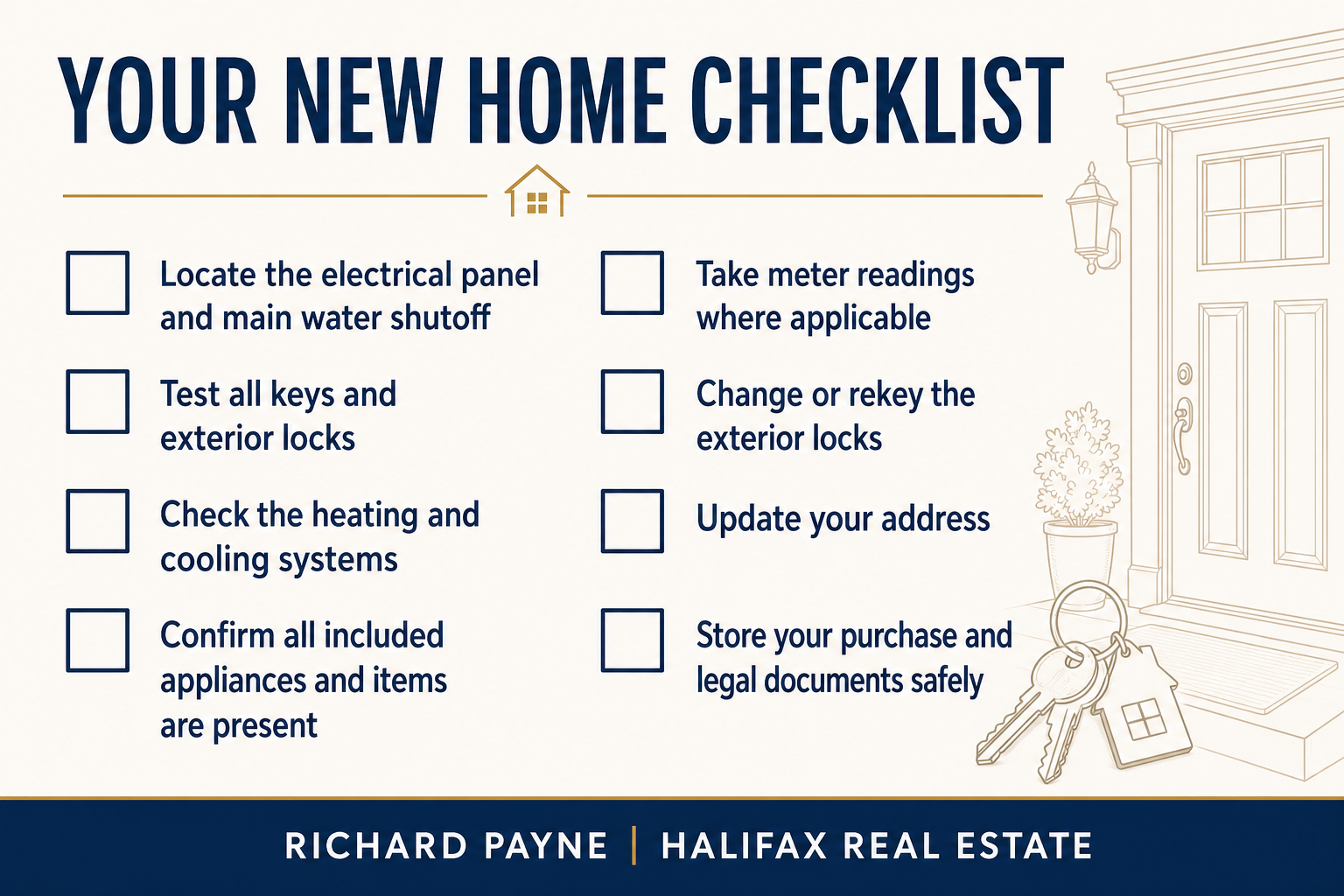
Your lawyer will normally provide a final report after closing. This package may include copies of the legal documents, the final financial accounting and other records relating to your purchase.
Keep these documents. You may need them if you refinance, sell or have a future question about the transaction.
Frequently Asked Questions
What time do you get your keys on closing day in Halifax?
There is no fixed key-release time. Many Halifax closings are completed during the afternoon, but it depends on when the mortgage funds arrive and when the lawyers complete the transaction. Avoid booking movers for the morning and remain flexible until your agent confirms the keys can be released.
Do I sign my documents on closing day?
Usually, buyers meet with their real estate lawyer and sign the required documents before closing day, often one to three business days beforehand. Your lawyer will arrange the appointment and tell you what identification, documents and funds to bring.
Do I need to visit my lawyer on the actual closing day?
Not usually. Most of the closing-day work happens between your lawyer, your lender and the seller’s lawyer. You should remain available in case additional information or a signature is required.
What should I bring to my lawyer’s closing appointment?
Bring the government-issued identification and any documents requested by your lawyer. You will also need to provide your closing funds using the payment method specified by the law firm. Confirm the exact amount, payment method and payee directly with your lawyer.
What is included in the Statement of Adjustments?
The Statement of Adjustments sets out the financial details of the transaction. It generally includes the purchase price, your deposit credit, property tax adjustments and any applicable fuel or other agreed adjustments. Your legal account, deed transfer tax and additional closing expenses may be presented separately depending on your lawyer’s reporting format.
How much is the deed transfer tax in Halifax?
The municipal deed transfer tax within Halifax Regional Municipality is generally 1.5% of the purchase price. Certain non-resident buyers may also be subject to Nova Scotia’s provincial Non-resident Deed Transfer Tax. Ask your lawyer which taxes apply to your circumstances.
What happens if the seller has not moved out?
The seller must provide possession in accordance with the Agreement of Purchase and Sale. If the seller has not vacated when required or the property has not been left in the agreed condition, contact your real estate agent immediately. Your agent and lawyer can advise you on the appropriate next steps.
Can a house closing be delayed until the next business day?
Yes. Although most issues are resolved on the scheduled closing date, a significant financing, documentation or legal problem could delay completion. This is one reason not to schedule an early move or create deadlines that depend on receiving the keys at a particular time.
Final Thoughts
Closing day is much easier when you understand what happens behind the scenes.
Your lawyer handles most of the legal and financial work, while your job is to provide the requested information, arrange your insurance, sign the documents and make sure your closing funds are ready.
Whether you’re buying in Bedford, Fall River, Hammonds Plains, Dartmouth or elsewhere in HRM, good preparation will help make the final handover as smooth as possible.
If you’re planning to buy a home in Halifax and want clear guidance from the accepted offer through to closing day, book a free 30-minute strategy call. We can discuss your timing, the buying process and the practical steps you should take before receiving the keys.
Book your call: https://calendly.com/richardpayne/initial-consult
The closing process and costs can vary by property, lender and agreement. Your real estate lawyer should provide legal advice specific to your transaction.
About Richard Payne
Richard Payne is a REALTOR® with eXp Realty of Canada, bringing 14 years of Halifax real estate experience and more than $165 million in sales across 339 closed transactions. He helps families, professionals and relocators buy and sell homes throughout Halifax Regional Municipality, with particular expertise in Fall River, Bedford, Hammonds Plains and surrounding communities.





 EN
EN
 FR
FR